
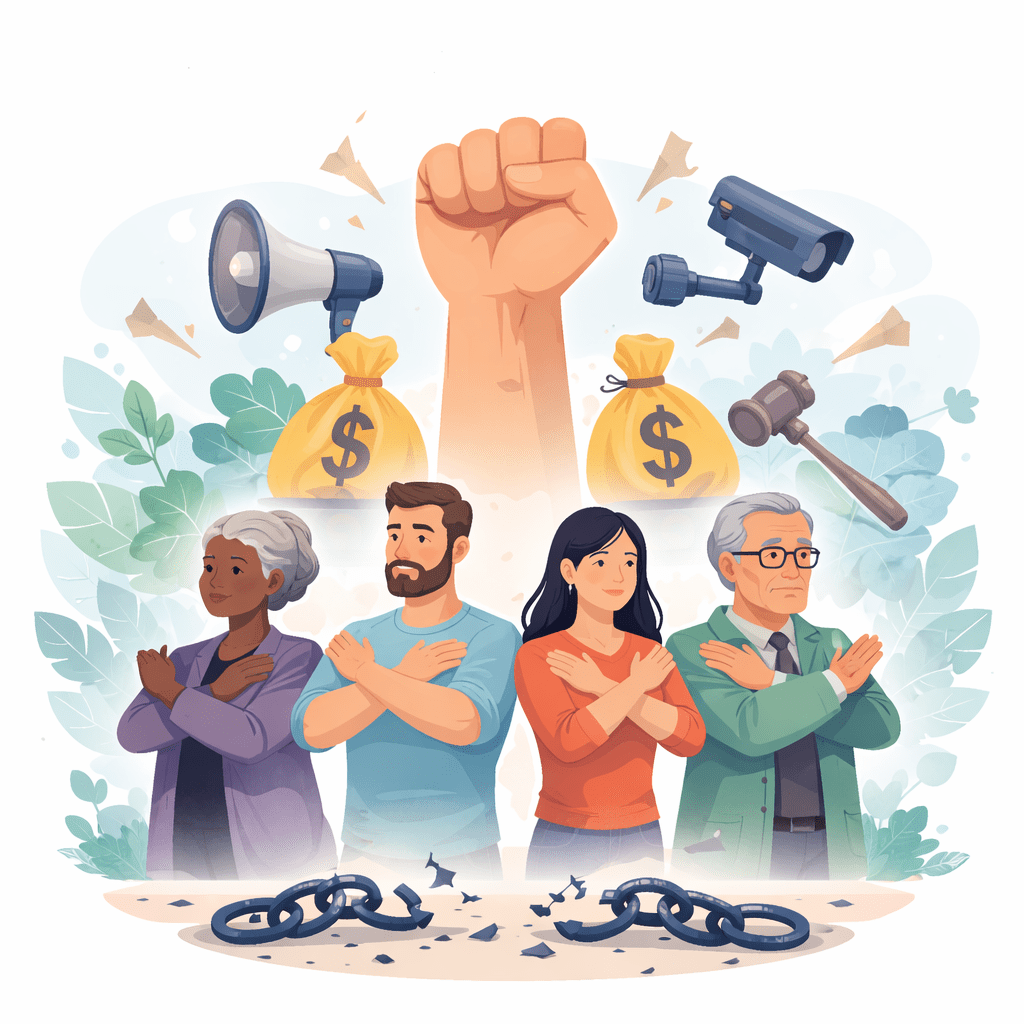
We are living through a time that feels like an earthquake — political, moral, and emotional. When the ground shifts this violently, fear is not proof that we are failing. Fear is proof that we are awake.
Nothing is set in stone. We still have choice — including the choice to respond without becoming what we oppose.
When confusion rises and the mind begins to spin, the heart can steady the next step: disciplined, lawful action that protects human dignity without surrendering to despair. This is how we keep our humanity intact while resisting what is intolerable.
Moral Reality, Civic Clarity
Before turning to how citizens respond, we must be honest about why so many Americans feel shaken. Donald J. Trump’s second election did not occur in ignorance. The moral and civic record was public before the vote.Among the facts already known:
- He is a convicted criminal.
- He presided over multiple business bankruptcies.
- He was found liable for sexual abuse in civil court.
- He was recorded, in his own voice, boasting that fame allowed him to sexually assault women without consequence, dismissing consent as irrelevant when power is involved.
- He repeatedly demeaned women, minorities, immigrants, and the disabled, and used dehumanizing rhetoric as a political tool.
- He trafficked in demonstrably false claims as a governing strategy.
- He refused to accept the certified results of the 2020 election, and promoted false claims of a stolen election long after courts, state officials, and his own administration’s processes failed to substantiate them.
- His rhetoric and actions helped create the conditions that culminated in the January 6 attack on the U.S. Capitol, an event widely described as an insurrection attempt — and he has continued to minimize, excuse, or politically exploit it rather than fully reckon with it.
These were not revelations discovered later. They were facts and patterns visible to the public beforehand. Naming them is not cruelty. It is civic clarity. Democracies require citizens to face the consequences of the leaders they choose — especially when those consequences spill onto peaceful protesters, vulnerable communities, and the rule of law itself.
Non-Cooperation
Authoritarian systems do not fall because citizens take up arms. They fall when citizens withdraw cooperation — calmly, lawfully, and together.
History shows that governments depend far more on consent than on force. When legitimacy erodes, power hollows out from the inside.
Economic Boycotts (Targeted, Sustained, Lawful)
Money is treated as speech in America — and so is the refusal to spend it.
- Boycott corporations that fund or enable authoritarian policies
- Divest from companies profiting from detention, militarization, or repression
- Shift spending to local, ethical, and cooperative businesses
- Publicly articulate why dollars are being withheld
Boycotts work not because they are dramatic, but because they are predictable and persistent.
Other forms of non-cooperation exist, such as lawful forms of labor protest and collective bargaining, refusal to participate in unilateral change, such as renaming buildings. This is not refusal of law; It is refusal of legitimacy.
Change is often forced through local primaries and elections. Local power can constrain national power. Support for civil-liberties organizations, civil litigation and court-watching can force accountability into the public record
Propaganda collapses when enough people name reality together, through writing, teaching, art, music, testimony and refusing euphemisms. Authoritarianism feeds on confusion. Clarity is resistance.
Every system depends on professionals choosing to comply. Whistleblowing, ethical refusals, public resignations and internal dissent lean hard against a regime. No regime survives when its own administrators stop believing.
Disciplined, nonviolent protest is not weakness it is strategy. Sit-ins, vigils, marches all evoke fear and often rage in tyrants. Violence justifies repression. Nonviolence exposes it.
Why This Works (Across Time)
Governments do not collapse when people fight them.
They collapse when people stop feeding them:
- With labor
- With money
- With belief
- With legitimacy
States cannot tax what is not produced.
They cannot govern what will not consent.
They cannot rule people who refuse to be morally anesthetized.
From Montgomery to the Present Moment
The Montgomery Bus Boycott (1955–56) remains the clearest proof that lawful, disciplined non-cooperation can force change without violence. It worked because it was voluntary, sustained, morally clear, and economically targeted.
That same principle has operated repeatedly since. In our own time, public pressure — expressed through collective voice and sustained attention — has helped preserve independent cultural spaces, including late-night comedy. Shows like Jimmy Kimmel Live! and other late-night programs now function as one of the last widely accessible platforms for dissent, satire, and truth-telling, at a moment when much of corporate media has been consolidated under oligarchic control. Satire punctures propaganda. Laughter breaks fear.
From Power Concentration to Consumer Choice
On January 20, 2025, Donald Trump was surrounded — literally and symbolically — by some of the world’s wealthiest corporate leaders. Their presence at inauguration events was widely reported and visually documented, underscoring the ongoing proximity between corporate power and political authority in the United States.
Attendance at an inauguration does not imply identical motives or identical levels of political endorsement. It does, however, signal access, alignment, and influence. In a market democracy where money is treated as speech, citizens are entitled to respond with choices of their own.
Attendance at a presidential inauguration is not a neutral act. No corporate leader or billionaire is compelled to be there. These individuals are among the most informed and well-advised people in the world, with access to the same public record available to all voters — and far more besides.
By choosing to appear prominently at inauguration events, they made a public choice. Whatever their private intentions, that choice conveyed alignment, access, and normalization. In a media-driven society, proximity to power is itself a form of speech. Silence, absence, or distance were available options. They were not chosen.
In moments of moral clarity, optics are not trivial. They shape legitimacy. And legitimacy is the currency on which both political and corporate power depend.
Below are prominent billionaires and high-net-worth executives reported as standing near or attending events around the 2025 inauguration, followed by the corporations they lead and lawful alternatives consumers may choose.
Corporate Leaders Present & Their Leadership Roles
Elon Musk, CEO: Tesla, CEO/Lead: SpaceX, Owner: X (formerly Twitter)
Jeff Bezos, Founder & Executive Chairman: Amazon, Founder: Blue Origin,
Owner (private): The Washington Post
Mark Zuckerberg, CEO: Meta Platforms (Facebook, Instagram, WhatsApp)
Sundar Pichai, CEO: Alphabet / Google
Tim Cook, CEO: Apple
Sergey Brin, Co-founder: Alphabet / Google
Sam Altman, CEO: OpenAI
Miriam Adelson, Owner / Executive: Las Vegas Sands (casino and hospitality)
Rupert Murdoch, Founder / Executive Chairman: Fox Corporation
(Additional wealthy figures attended surrounding events; this list reflects the most visible corporate leaders commonly cited in reporting and imagery.)
Some people march. Others cannot. Yet millions can act — quietly, lawfully, and together — by choosing where their money, attention, and trust go. That is how democracy and human rights survive.
 The Liberty and Prosperity Plan
Leave a comment