About The Liberty and Prosperity Plan
We don’t need a perfect world.
We need a just one that works in the real one.
The Liberty and Prosperity Plan is rooted in a simple, grounded idea:
Healthy societies emerge when the systems that govern land, money, labor, health, and power are designed to support human flourishing — not extraction.
This project is informed by whole-systems thinking (the lens of geography): how people, places, economies, and ecosystems interact across space and time. Problems that look “separate” — housing, healthcare, wildfires, social unrest, budgets — often share the same root causes: misaligned incentives and damaged systems.
The Foundation: We Cannot Have Liberty on a Dying Landscape
Ecosystem restoration is not a “nice extra.” It is civilization insurance.
When landscapes degrade — when soils die, watersheds fail, and vegetation collapses — the consequences are not only environmental. They become:
- higher wildfire intensity and frequency
- water scarcity
- crop failures and price spikes
- mass displacement and migration
- rising conflict and humanitarian crises
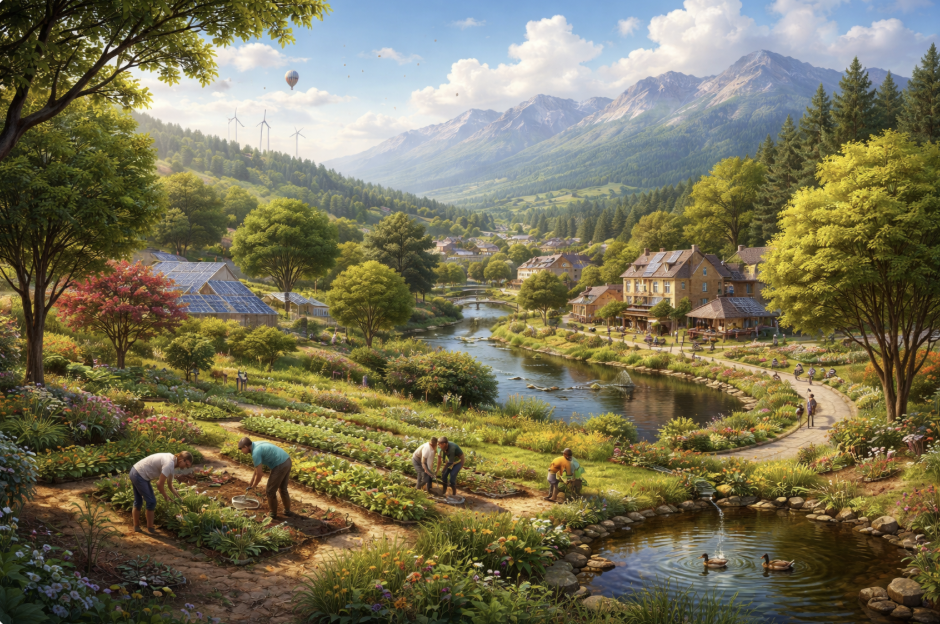
A permaculture-informed approach (watershed repair, soil regeneration, re-vegetation, shade and canopy restoration, fire-wise design) is not just “gardening.” It is risk reduction and public safety.
In wildfire country, the warning is simple:
If we do not restore land and water systems, some regions will cross a threshold where forests don’t return — and the future becomes desert.
We don’t need utopia.
We need to keep the ground beneath our feet alive.
What This Site Is
The Liberty and Prosperity Plan is a living framework for:
- restoring constitutional liberties
- building economic fairness
- protecting human dignity
- repairing ecosystems
- strengthening communities
- and creating long-term stability for future generations
It is not a party platform.
It is not a brand.
It is not a product.
It is a place for clear thinking about how a free society can also be a humane one.
A Simple Cost–Benefit Lens
Most public debates use short-term accounting:
- “How much does this cost this year?”
- “Will my taxes go up?”
But the real question is systems math:
- “How much does instability cost over ten years?”
- “What costs disappear when a society becomes healthier and safer?”
When we invest upstream in:
- fire prevention through ecosystem restoration
- walkable communities that reduce chronic disease
- catastrophe support that helps people recover without lifelong dependence
- fair economic rules that prevent desperation
- diplomacy that prevents war
we reduce downstream spending on:
- emergency response and disaster cleanup
- insurance collapse and rebuilding costs
- hospital and chronic disease costs
- incarceration and social breakdown
- prolonged wars and refugee crises
This is not charity.
It is smart prevention — cheaper than crisis management.
“Fair Share” Funding: Those Who Face Higher Risk Help Fund Prevention
One practical principle runs through this plan:
Costs should be carried as close as possible to where risk is created — and savings should benefit everyone.
For example, in wildfire regions, people living in Urban–Wildland Interface (UWI) areas receive a higher level of public risk protection. A fair approach is to fund prevention locally through fire protection systems, such as:
- local fire district assessments or parcel fees dedicated specifically to prevention
- community-level permaculture design for water retention and fuel management
- ongoing eco-monitoring (soil moisture, vegetation health, erosion control)
- restoration projects that reduce catastrophic fire behavior
- hardened community infrastructure (evacuation routes, defensible space planning)
This is the same logic as:
- flood districts paying for levees
- road users paying fuel taxes
- insurance pooling risk
Prevention is not free.
But it is far less expensive than repeated catastrophe — and it protects lives, homes, and the broader economy.
What This Site Is Not
This is not a space for:
- demonizing whole groups
- outrage cycles
- tribal loyalty
- fantasies of total control
Human beings are not perfect.
So we design systems that don’t require perfection to work.
The goal is not to create saints.
The goal is to create structures that reduce harm, reward contribution, and prevent abuse of power.
Who This Is For
This project is for people who believe:
- personal responsibility and compassion belong together
- liberty and justice are not opposites
- fear should never be a governing tool
- and the future should be livable for our children
You don’t have to agree with every essay here.
You only have to agree on this:
A society that works only for the powerful is not free — and a society that burns its own landscape cannot remain stable.
A Living Work
The Liberty and Prosperity Plan is not finished.
Like any healthy ecosystem, it evolves through:
- reflection
- dialogue
- and real-world learning
We don’t need utopia.
We need systems that let people and places thrive together — with real incentives, real responsibility, and real care for the land that sustains us.
 The Liberty and Prosperity Plan
Leave a comment