
What if the problem is not waste itself, but the way we have designed our systems?
Again and again, we see mountains of material piled up as if they are useless leftovers: dairy manure concentrated into lagoons and heaps that threaten groundwater, sawdust and wood waste stacked into piles that can become fire hazards, agricultural land left stripped of life and organic matter, communities left with the cost of pollution and risk. We call these things “waste,” but that word may be hiding the deeper truth. In nature, there is no waste. There are only materials moving through cycles. What one process sheds, another process uses.
When we break those cycles, we create danger.
The hidden opportunity is that design can be changed.
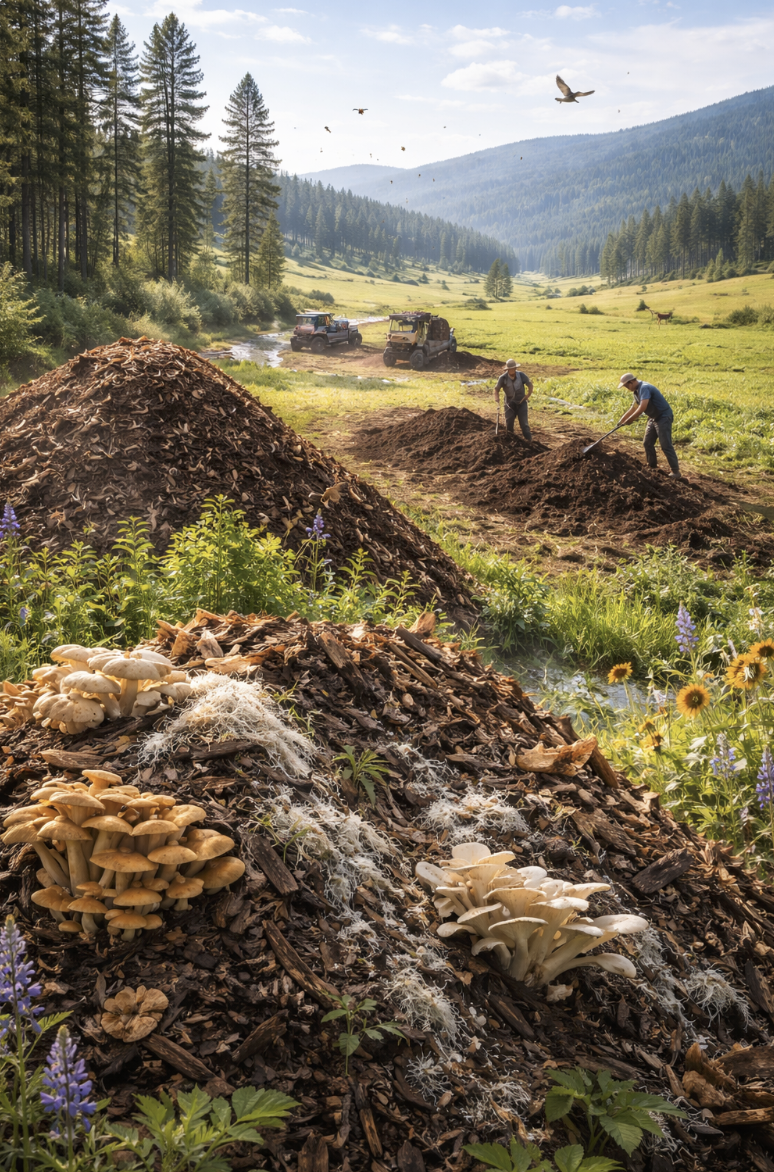
Imagine a regional system that treats so-called waste streams as feedstocks for restoration. Clean woody biomass could be chipped and blended in managed ratios with manure or other nutrient-rich organic materials. Native fungi, compost biology, and careful curing could help transform raw inputs into stable soil-building amendments. Instead of leaving piles to leach, burn, rot badly, or smolder, we could convert them into something useful: carbon, cover, moisture retention, biological life, and eventual fertility for degraded lands that need healing.
That does not mean being careless. Contaminated manure should not simply be scattered thinly and forgotten. The answer is not dilution and denial. The answer is to stabilize, test, convert, and strategically apply. Inputs should be screened. Piles should be managed for heat, moisture, and pathogens. Finished material should be tested for salts, nutrients, and contaminants. Land application should happen only where soil type, slope, water protection, and restoration goals make sense. The point is not to spread pollution around. The point is to prevent concentrated harm and transform materials through intelligence and stewardship.
In other words: not disposal, but conversion.
And this is where another kind of hidden opportunity comes into view — the opportunity to reconnect human beings with meaningful work.
There have always been people who would gladly spend their days outdoors, using their strength and skill to help restore a landscape. There are people who would take pride in building compost systems, inoculating biomass, monitoring soil recovery, hauling materials, managing logistics, tracking data, planting native species, moving water responsibly, or caring for grazed land. There are others who would gladly do the lab work, the planning, the organizing, the administration, the engineering, or the public education needed to support such efforts. Human beings often want to contribute. They want their labor to matter. They want to be part of something coherent, practical, and alive.
Yet we keep building systems that produce the opposite: dead-end disposal, preventable hazards, and people cut off from purposeful work.
What if those problems belong to the same unfinished opportunity?
A healthier system would ask, before waste is ever created: who is responsible for funding its safe return to the cycle? We already understand this principle in other contexts. A bottle deposit helps pay for recovery at the front end. Similar thinking could apply to concentrated manure, biomass waste, and other restoration-worthy materials. The cost of repair should be built into the system from the beginning instead of pushed downstream onto neighbors, taxpayers, or future generations.
That shift would do more than reduce pollution and fire risk. It would create jobs rooted in repair rather than extraction. It would turn disposal costs into restoration investments. It would help land hold more moisture, store more carbon, support more life, and become more resilient. It would also give communities a chance to participate in something better than endless reaction to crisis.
We need fewer piles, fewer hazards, fewer excuses, and more cycles.
There is no waste in nature. Waste appears when human design forgets how to listen.
If we listen again — to soil biology, to fire ecology, to hydrology, to labor, to common sense — then the so-called wastes around us start to look different. They begin to look like misplaced resources waiting for a better plan.
And perhaps that is the real task before us now:
not merely cleaning up the mess,
but redesigning the system so the mess is not produced in the first place.
 The Liberty and Prosperity Plan
Leave a comment